
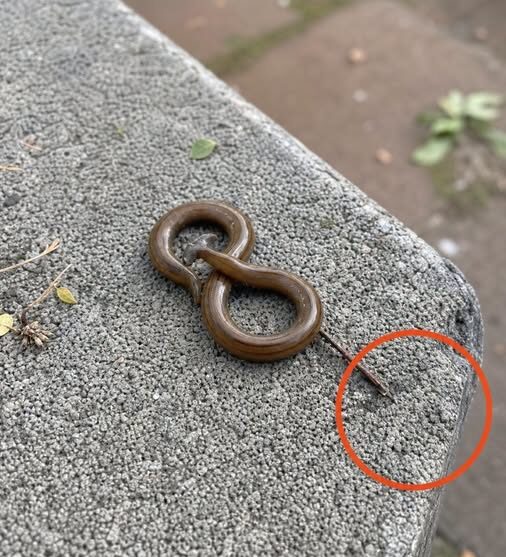
I Thought It Was Just a Strange Worm — Then I Learned What It Was Hunting
A Strange Shape on the Wet Ground
I noticed the creature before I understood why it made me uncomfortable.
It was moving slowly across the damp ground, dark and unusually smooth, with a motion that did not resemble the familiar wriggling of an ordinary earthworm.
Its body seemed to glide.
Then I noticed the head.
It was broad and flattened, almost shovel-shaped, giving the creature an appearance that immediately set it apart from anything I expected to find crawling nearby.
For a moment, curiosity won over caution.
Something About Its Movement Felt Different
The animal was not rushing.
It moved with a steady, deliberate pace.
There was something unsettling about how controlled the movement appeared.
Instead of twisting and burrowing like an earthworm, it seemed to slide across the surface as though it were following a route.
I found myself watching more closely.
The longer I looked, the more I realized that whatever I was seeing was not simply an unusually shaped worm.
The Head Was the Biggest Clue
The most distinctive feature was the flattened head.
Its unusual shape gave the creature the appearance of a tiny hammer or shovel.
That feature eventually helped me understand what I had encountered.
It was a hammerhead worm, a type of terrestrial flatworm.
Once I knew the name, the strange appearance suddenly made sense.
What looked unfamiliar because I had never paid attention to it before actually belonged to an entirely different group of animals from the earthworms I was used to seeing.
A Flatworm That Glides Across the Ground
Hammerhead worms move differently from common earthworms.
Rather than using the same familiar contracting and stretching motion, they appear to glide across moist surfaces.
That smooth movement was exactly what had caught my attention in the first place.
It also contributed to the strange feeling that the animal seemed almost purposeful as it crossed the ground.
Once I learned more, that impression became even more interesting.
This Was Not a Harmless Soil Helper
Earthworms are often associated with healthy soil.
People see them in gardens and think of decomposition, soil structure, and the underground processes that support plant life.
The hammerhead worm occupies a very different role.
It is a predator.
Instead of quietly contributing to the same soil ecosystem as earthworms, it hunts them.
That fact completely changed the way I viewed the creature I had nearly dismissed.
The Creature Was Searching for Prey
The slow, deliberate movement no longer seemed random once I learned about its behavior.
Hammerhead worms can actively hunt other soil animals, including earthworms.
The creature I had watched sliding across the wet ground may have been searching for exactly that kind of prey.
Suddenly, the movement that had seemed merely strange took on another meaning.
I had not been watching an animal wandering aimlessly.
I had been watching a predator moving through its environment.
A Predator Hidden in Plain Sight
Predators are often imagined as large, fast, or dramatic animals.
We picture sharp teeth, powerful jaws, claws, or sudden attacks.
The hammerhead worm does not fit that image.
It is quiet.
It moves slowly.
It can easily be overlooked.
That makes learning about its predatory behavior especially surprising.
Something that looks so simple can occupy a far more complex role in the ecosystem than its appearance suggests.
The Difference Between Earthworms and Hammerhead Worms
From a distance, it would be easy for someone unfamiliar with hammerhead worms to assume they are simply unusual earthworms.
But their behavior is fundamentally different.
Earthworms spend much of their lives moving through soil and organic matter.
Hammerhead worms are terrestrial flatworms that can actively pursue prey.
That difference matters because the two animals play very different roles in the same environment.
The Hunt Can Involve Toxins
One of the most unsettling details I later learned was that hammerhead worms can use toxins as part of their predatory behavior.
This adds another layer to an animal that already looks unusual.
The flat, distinctive head and gliding motion may draw attention first.
But the biology behind the creature is what makes the encounter truly memorable.
It is not simply shaped differently from an earthworm.
It is adapted to a completely different way of surviving.
The Encounter Changed Once I Understood What I Was Seeing
Before learning the animal’s identity, I saw only a strange shape moving through the grass and wet soil.
Afterward, I saw the same moment differently.
The creature had become an example of how easily unfamiliar wildlife can be misunderstood.
Had I judged it only by appearance, I might have described it as an odd worm and forgotten about it.
Knowing its role transformed the encounter.
The Quiet Life Beneath Our Feet
Most people walk across soil without thinking much about what is happening underneath or around them.
Yet even a small patch of damp ground can contain complicated relationships between predators, prey, decomposers, insects, worms, and microorganisms.
The hammerhead worm became a visible reminder of that hidden world.
It showed me that ecological interactions can occur on a scale small enough to be missed entirely unless someone stops to look.
What Appears Simple May Be Complex
The encounter also reminded me how unreliable first impressions can be.
I initially saw something that looked like a worm.
That description was technically understandable, but it did not explain much.
The more important question was what kind of worm-like animal it was and what role it played.
Once those questions were considered, the creature became far more interesting.
Why Caution Matters Around Unfamiliar Wildlife
Curiosity naturally makes people want to move closer to unusual animals.
Sometimes the instinct is to touch them, pick them up, or move them somewhere else.
My experience reinforced a simpler approach.
When an unfamiliar creature appears, observing from a safe distance is often enough.
There is no need to handle something simply because it looks unusual.
Watching carefully can provide more information without disturbing the animal or creating unnecessary risk.
Not Every Strange Animal Needs Human Intervention
It is easy to assume that encountering something unfamiliar requires immediate action.
Sometimes it does not.
The hammerhead worm I saw was simply moving through its environment.
By choosing to watch instead of interfering, I was able to notice its shape, movement, and behavior without changing what it was doing.
That distance eventually became one of the most valuable parts of the experience.
The Creature Became a Lesson Rather Than a Scare
At first, the encounter carried an element of unease.
The unfamiliar head shape and slow movement made the animal look almost alien.
Learning that it was a predator added another unsettling detail.
But I did not walk away thinking of the moment as a horror story.
Instead, it became a lesson in how little we often understand about the organisms around us.
Nature Rarely Fits Simple Categories
People often divide animals into convenient groups.
Some are considered helpful.
Some are considered harmful.
Some are ignored because they seem too small to matter.
The hammerhead worm complicated those categories.
It was small enough to overlook but biologically fascinating enough to completely change the way I thought about the ground beneath my feet.
Earthworms and the Hidden Balance of Soil Life
Learning that hammerhead worms prey on earthworms made the encounter particularly striking.
Earthworms are among the most familiar animals people encounter in soil.
They are so common that their presence often goes unnoticed.
Yet they are part of a larger web of life that includes animals adapted specifically to hunt them.
The hammerhead worm was a reminder that even familiar ecosystems contain relationships most of us never witness.
A Predator Does Not Need to Look Dramatic
The creature did not chase prey at high speed.
It did not make noise.
It did not display the obvious weapons associated with larger predators.
Its hunting style was quiet and patient.
That was perhaps the most unsettling part of learning what it was.
The same smooth movement that initially seemed almost graceful was part of a predatory life.
The Shovel-Shaped Head Is Hard to Forget
Once someone has seen a hammerhead worm clearly, its head is likely to be the feature they remember.
The broad shape is so different from the rounded end people associate with ordinary worms that it immediately attracts attention.
For me, that distinctive head became the detail that turned a passing observation into a question.
Without it, I might never have stopped.
Curiosity Is Valuable When Paired With Restraint
The experience did not make me less curious about wildlife.
If anything, it made me more curious.
But it also reinforced the importance of restraint.
Looking closely does not have to mean touching.
Learning does not require disturbing an animal.
Sometimes observation is the better way to understand what is happening.
The World Is Full of Lives We Barely Notice
The hammerhead worm encounter stayed with me because of how easy it would have been to miss.
I could have walked past without giving the animal another thought.
Instead, one unusual movement made me stop.
That small pause revealed a creature with a life and ecological role very different from what I had assumed.
It reminded me that countless interactions are unfolding around us every day without attracting our attention.
My First Assumption Was Wrong
I thought I had seen an odd-looking worm.
That was only the surface of the story.
I had actually encountered a terrestrial flatworm with predatory behavior, distinctive movement, and a specialized place within its environment.
The gap between my first assumption and what I later learned was the most valuable part of the experience.
A Small Encounter Became a Reminder About Humility
Nature has a way of exposing how much we do not know.
A creature only inches away can belong to a world of behaviors and relationships that are completely invisible to us at first glance.
That realization is humbling.
It encourages curiosity without assuming immediate understanding.
It also reminds us that unfamiliar does not automatically mean meaningless.
Sometimes the Best Choice Is Simply to Observe
I did not need to pick up the hammerhead worm to learn from it.
I did not need to interfere with its movement.
I simply watched.
That decision allowed the encounter to remain what it was: a brief look into a part of the natural world I had barely noticed before.
I walked away with a greater appreciation for caution and for the value of learning before acting.
The Strange Worm Was More Than It Seemed
What initially appeared to be a long, dark worm on wet ground turned out to be something far more complex.
Its flattened head, gliding movement, and predatory behavior revealed a life very different from that of the familiar earthworms nearby.
The discovery changed how I viewed the small creature and, in a way, how I viewed the ground itself.
There was far more happening there than I had ever noticed.
A Quiet Lesson From an Unexpected Encounter
The hammerhead worm did not chase me.
It did not create a dramatic confrontation.
It simply moved through its environment while I watched.
Yet the encounter stayed with me.
It reminded me that the natural world does not need to be large or spectacular to be fascinating.
Sometimes the most memorable discoveries are hidden in plain sight.
All they require is enough curiosity to notice them and enough humility to admit that what we first think we are seeing may not be the whole story.