
Small Detail on Lindsay Clancy’s Wheelchair Sparks Online Backlash as Murder Trial Ends in Mistrial
A Sticker Seen During Jury Deliberations Draws Attention
A small detail spotted on Lindsay Clancy’s wheelchair during her closely watched murder trial has generated criticism online, with some people questioning the meaning behind a sticker attached to her drink holder.
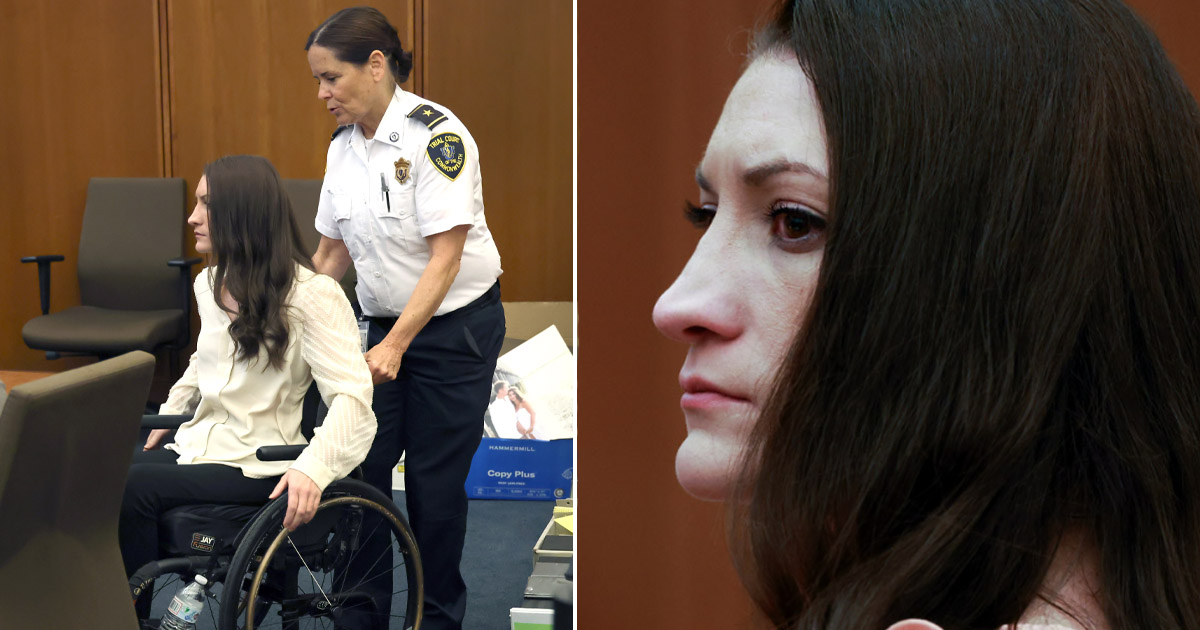
Clancy, a Massachusetts mother accused of killing her three young children, was photographed with a pink sticker on the drink holder attached to her wheelchair while jurors were continuing their deliberations.
The holder contained a Diet Coke when it was photographed on Wednesday, September 2.
The sticker displayed the phrase “#sidebah.”
Although the detail was small, it quickly became a point of discussion among people following the proceedings.
The Phrase Appears to Reference a Courtroom Expression
The wording on the sticker appears to be connected to Clancy’s defense attorney, Kevin Reddington.
The phrase seemingly references the way Reddington pronounces the courtroom term “sidebar” with his Boston accent.
There is no confirmation about who placed the sticker on the wheelchair.
It is therefore unknown whether Clancy herself selected it, approved it or had any involvement in attaching it.
Despite that uncertainty, some people following the case interpreted the sticker as an attempt at humor connected to the trial.
That interpretation led to angry reactions online because of the extremely serious allegations at the center of the case.
Some Trial Watchers Reacted Angrily
People discussing the photograph on social media questioned whether a lighthearted reference was appropriate during proceedings involving the deaths of three children.
One commenter wrote, “#LindsayClancy has the audacity to put a ‘joke’ sticker ‘SideBah’ on her drink holder?!?!!! Does she think that’s all a joke?!”
Another person reacted even more strongly.
“The kids are in the ground and she thinks this is a damn joke ?? Tell me that’s not who she is.”
The reactions reflect how closely even minor courtroom details have been examined during the case.
However, because the person responsible for placing the sticker on the wheelchair has not been identified, the sticker itself does not establish anything about Clancy’s intentions or attitude toward the proceedings.
The Case Involves the Deaths of Three Children
Clancy is accused of killing her three children at the family home in Duxbury, Massachusetts.
The children were 5-year-old Cora, 3-year-old Dawson and eight-month-old Callan.
Prosecutors allege that Clancy used exercise bands to kill the children inside the home.
They have also described what happened afterward as an attempt by Clancy to take her own life.
After the children were harmed, Clancy slit her wrists and throat and jumped from the second story of the house.
She survived but was left partially paralyzed.
Her resulting physical condition is why she has appeared in court using a wheelchair.
The Defense Centers on Her Mental State
Clancy’s defense does not dispute that the children died, but her attorneys have argued that she should not be held criminally responsible for what happened.
The central issue raised by the defense is her mental state at the time of the killings.
Clancy has argued that she was suffering from severe postpartum psychosis.
Her attorneys have therefore asked that her condition be considered when determining whether she can be held criminally responsible for the deaths.
The question of criminal responsibility became one of the most important issues jurors were asked to consider during the trial.
The case consequently involved not only the events inside the family home, but also competing arguments surrounding Clancy’s state of mind.
The Sticker Controversy Emerged Near a Critical Point
The debate over the sticker arose while jurors were attempting to reach a verdict.
By that stage, the trial had already reached its final phase and both sides had presented their cases.
Jurors were tasked with deciding whether the evidence and arguments were sufficient to reach a unanimous conclusion.
The photograph showing the “#sidebah” sticker circulated as the deliberations continued.
Because the case had attracted significant attention, the detail quickly became another topic of public discussion.
Yet the courtroom process ultimately ended without a final verdict.
Judge Declares a Mistrial
After approximately a week of deliberations, the jury was unable to reach a unanimous decision.
The judge ultimately declared a mistrial.
A mistrial means that the proceedings ended without the jury returning the unanimous verdict required to resolve the charges.
The declaration does not amount to a finding that Clancy is guilty.
It also does not amount to a finding that she is innocent.
Instead, the charges remain unresolved because the jurors could not reach the agreement necessary to conclude the case.
That leaves prosecutors and Clancy’s defense team facing another important decision about what should happen next.
The Murder Charges Remain in Place
The mistrial does not automatically eliminate the charges against Clancy.
For now, she continues to face the same murder charges connected to the deaths of her three children.
Her legal situation therefore remains active despite the end of this particular trial.
The prosecution will now have to decide how it wants to proceed following the jury’s inability to reach a verdict.
Several possibilities remain available.
Prosecutors Could Seek Another Trial
One option is to try the case again.
If prosecutors choose that route, a new jury could be selected and the case could return to court for another trial.
A retrial would once again require both sides to present their positions and would give a new group of jurors responsibility for reaching a verdict.
The mistrial does not prevent prosecutors from pursuing that possibility.
Whether they ultimately do so remains undecided.
A Plea Agreement Is Another Possibility
Prosecutors could also explore a negotiated resolution with Clancy’s attorneys.
That could involve discussions about a potential plea agreement rather than proceeding through another complete trial.
Such an outcome would depend on whether both sides could agree to acceptable terms.
No such agreement has been established in the information currently available.
The option nevertheless remains one of the possible paths following the mistrial.
The Charges Could Also Be Dropped
Another possibility would be for prosecutors to decide not to continue pursuing the case.
That could result in the charges being dropped.
At this stage, however, that has not happened.
Clancy remains charged, and no final decision about another trial, a plea agreement or dismissal of the charges has been announced in the information presented.
Until prosecutors determine their next move, the legal case remains unresolved.
Clancy Remains at a Mental Health Facility
While the prosecution and defense consider the next stage of the case, Clancy will remain at the mental health facility where she is currently being held.
Her status does not automatically change because the first jury failed to reach a verdict.
The mistrial simply means the proceedings that had been underway ended without a final determination of criminal responsibility.
Any further resolution will depend on what happens next in the legal process.
Public Attention Remains Intense
The reaction to the wheelchair sticker illustrates the level of public attention surrounding the case.
A phrase printed on a small sticker was enough to trigger widespread discussion because of the seriousness of the allegations and the emotional nature of the trial.
For critics, the apparent courtroom joke seemed inappropriate given that three young children had died.
At the same time, there is no confirmed information showing that Clancy was responsible for putting the sticker on her wheelchair.
That uncertainty remains important when interpreting the photograph.
The existence of the sticker is clear, but its origin and Clancy’s involvement with it are not.
The Legal Questions Remain Unanswered
The public controversy surrounding the sticker ultimately does not resolve the central legal questions in the case.
Prosecutors accuse Clancy of killing Cora, Dawson and Callan inside their Massachusetts home.
Her defense argues that severe postpartum psychosis affected her ability to be held criminally responsible.
Jurors considered those issues but were unable to reach a unanimous verdict after a week of deliberations.
As a result, the first trial concluded with a mistrial rather than a conviction or acquittal.
The next phase could include another trial, negotiations between prosecutors and the defense, or a decision not to continue pursuing the charges.
Until one of those paths is chosen, Clancy remains under the existing murder charges and continues to be held at a mental health facility.
The sticker may have become the latest detail to ignite debate around the proceedings, but the larger and much more consequential question now is whether prosecutors will ask another jury to decide the case.