
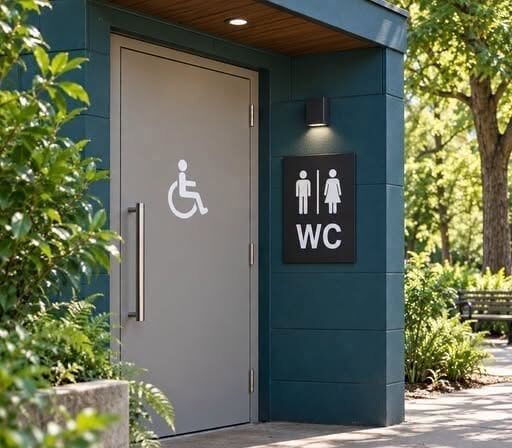
What Does “WC” Mean on a Restroom Door? The Simple Answer Goes Back Centuries
Those Two Familiar Letters Still Appear on Restroom Signs Around the World, but Their Original Meaning Comes From an Older English Term
If you have traveled through Europe or stayed in hotels abroad, you have probably seen the letters “WC” displayed on a restroom door.
The same abbreviation frequently appears in airports, restaurants, train stations and other public places.
For people accustomed to seeing words such as “bathroom” or “restroom,” the letters can initially seem unusual.
But their meaning is surprisingly simple.
WC stands for “water closet.”
Why Was It Called a Water Closet?
“Water closet” is an old English term used to describe a small room containing a toilet.
The word “closet” historically referred to a small private room rather than only the storage space that many people associate with the word today.
Adding “water” distinguished a room containing a flushing toilet from other small private rooms.
As indoor plumbing became increasingly common, the term became a familiar way of describing this particular room.
Eventually, the much shorter abbreviation WC became widely recognized.
The Flush Toilet Has a History Stretching Back Centuries
The story behind the term is also connected with the development of the flush toilet.
One important early example dates to 1596.
Sir John Harington described an early flushable toilet design that year.
Although toilets would continue developing considerably over the centuries that followed, his design became an important part of the history of modern sanitation.
Another significant development arrived nearly two centuries later.
Alexander Cumming Patented an Improved Design in 1775
In 1775, Alexander Cumming patented an improved toilet design.
One important feature was a water trap.
The design helped create a water barrier that could prevent unpleasant sewer gases from traveling back through the plumbing and entering the room.
Improvements like this helped make indoor toilets increasingly practical.
As plumbing technology developed further, toilets gradually became a more common feature inside buildings.
“Water Closet” Became Familiar During the 19th Century
During the 19th century, indoor toilets became increasingly common.
As this happened, “water closet” became a familiar term for a room containing one.
The abbreviation WC offered a convenient way to identify the room without writing the complete phrase.
Over time, those two letters remained recognizable even as everyday language changed.
That helps explain why WC can still be found on signs today.
Why Is WC More Common in Europe?
WC eventually developed into an internationally recognizable abbreviation, particularly across Europe.
That makes the label useful in places visited by people who may speak many different languages.
A traveler may not know the local word for restroom, but the letters WC can still provide a familiar clue.
This is why the abbreviation continues to appear in hotels, airports and other heavily traveled public spaces.
Americans Usually Use Different Words
In the United States, the terms “bathroom” and “restroom” became much more common in everyday speech.
As a result, many Americans rarely encounter WC at home.
They may first notice the abbreviation while traveling internationally.
Despite the difference in terminology, the meaning is straightforward.
When you see WC written on a door, the letters are simply an abbreviation for “water closet,” an older expression that has survived into modern life.
Two Letters With Centuries of History Behind Them
Today, few people walking into a WC are likely to think about the history behind the sign.
Yet those two letters connect modern travelers with terminology that developed alongside the spread of indoor plumbing.
From Sir John Harington’s early flushable toilet in 1596 to Alexander Cumming’s patented improvement in 1775 and the growing popularity of indoor toilets during the 19th century, sanitation changed dramatically.
The language surrounding it changed as well.
But one abbreviation survived.
So the next time you see “WC” on a restroom door, you will know exactly what it means: “water closet.”