
Mysterious Rusty Metal Object Found Buried Near an Old Creek Leaves People Guessing
Heavy Discovery Unearthed on a Northern Virginia Hillside Sparks Questions About Its Original Purpose
A heavily corroded metal object discovered beneath the soil in Northern Virginia has created an unusual identification mystery.
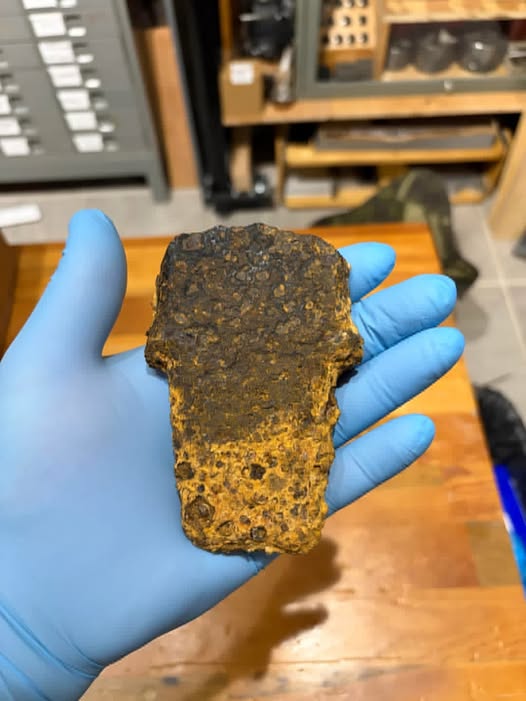
The object was found buried on a large hill near an old creek, where years of exposure to moisture and soil appear to have covered much of its surface with thick rust.
Its original shape is still partly visible, but oxidation has erased many of the smaller details that might have revealed how it was once used.
The combination of its weight, unusual outline, and blade-like edge has encouraged several possible explanations. However, no single theory has yet provided a definite answer.
A Surprising Find Beneath the Dirt
The metal piece was discovered in an area where the landscape includes a large hill and an old creek.
Objects buried in such environments can remain hidden for long periods, especially when soil movement, leaves, and natural debris gradually cover them.
When the item was removed from the ground, its heavy construction immediately stood out.
It did not appear to be a thin or decorative fragment. Instead, it seemed to be a solid piece of metal that may once have belonged to a tool or larger mechanical object.
The surface was covered with extensive oxidation. Thick rust had formed across nearly every visible section, creating a rough texture and making the original finish impossible to see.
Because corrosion can change the apparent shape of metal, some of the object’s current features may not perfectly reflect its original design.
Edges that were once smooth may now look uneven. Small openings, markings, or connecting points may also be hidden beneath layers of rust.
Its Shape Resembles an Old Axe Head
At first glance, the object bears some resemblance to an old iron axe head.
One side appears to have a blade-like edge, while small tabs extend from both sides of the object.
Those features have led some observers to wonder whether it was originally designed for cutting, splitting, or striking.
An axe head would normally include a clearly defined opening or attachment point for a wooden handle. In this case, years of corrosion make it difficult to determine whether such a feature was once present.
The object’s present condition also makes it hard to judge whether the apparent blade was intentionally sharpened or simply formed by damage and deterioration.
Although the axe-head theory is one of the most immediate possibilities, the unusual tabs and overall weight suggest that the item may have served a more specialized purpose.
It is possible that the visible shape represents only one section of a larger object that broke apart or became separated over time.
Years of Corrosion Hide Important Details
Rust is one of the greatest challenges when attempting to identify an old metal discovery.
As iron and similar metals oxidize, their surfaces gradually expand, flake, and lose definition.
Fine details that could help determine an object’s age or purpose may disappear completely.
A manufacturer’s mark, number, symbol, or decorative pattern could once have been present on this object, but none can be clearly identified through the heavy corrosion.
The oxidation may also conceal seams or holes that would show whether the piece was attached to a handle, machine, vehicle, or other structure.
Without those details, identification must rely mainly on the object’s size, weight, outline, and the location where it was discovered.
Even the location provides only limited clues. A creek and hillside could have been used for many different activities over the years.
The object might have been dropped where it was found, washed into the area by moving water, or buried after being discarded somewhere nearby.
Could It Have Been Part of an Old Tool?
One possibility is that the item was once part of a hand tool.
Its heavy metal construction would be consistent with equipment designed to withstand repeated impact or pressure.
The blade-like section could suggest a cutting or digging function, while the side tabs may have helped secure it to another component.
Tools used for outdoor work often become damaged, lost, or abandoned in rural areas.
If the surrounding hillside was once used for farming, clearing land, or maintaining the creek, a metal tool could have been left behind and gradually covered by soil.
However, the available description does not provide enough evidence to connect the discovery to any specific activity.
The object might resemble a familiar tool while actually belonging to a completely different type of equipment.
A Fragment of Older Equipment Is Another Possibility
The metal piece may also have been part of a larger machine or mechanical system.
Heavy equipment frequently includes thick iron components with unusual projections, mounting points, and reinforced edges.
Once separated from the rest of a machine, such pieces can be difficult to recognize.
A single rusted component may no longer resemble the equipment from which it came, particularly after decades of exposure underground.
The small tabs on both sides could have been used to hold the object in place, guide its movement, or connect it to surrounding parts.
The blade-like edge may also have served as a scraper, wedge, clamp, or support rather than a cutting surface.
Without additional pieces nearby, it is difficult to know whether the object functioned independently or was only one part of a larger device.
The Creekside Location Adds to the Mystery
The old creek near the discovery site introduces another layer of uncertainty.
Water can move heavy objects over time, especially during periods of flooding or erosion.
An item found beside a creek may not have originated at the exact location where it was uncovered.
It could have traveled from farther upstream before becoming trapped in soil along the hillside.
The creek may also have exposed an object that had previously been buried much deeper.
As water slowly removes soil from surrounding land, forgotten materials can begin appearing near the surface.
The hill could have contributed additional movement through erosion, shifting sediment downhill and covering the object repeatedly.
These natural processes make it difficult to use the discovery location as clear evidence of the object’s history.
Its Weight Suggests It Was Built for a Practical Purpose
The unusual weight of the object is one of its most noticeable characteristics.
A heavy metal piece was likely designed for strength, stability, or repeated use.
That makes it less likely to have been a lightweight household decoration or a purely ornamental item.
Its mass may have been necessary for cutting, crushing, anchoring, balancing, or supporting another structure.
At the same time, corrosion can add rough layers to the surface and make an object feel bulkier than it originally was.
Some metal may also have broken away, meaning the object’s present weight and shape may represent only part of its former condition.
Careful measurements of its length, width, thickness, and total weight could help narrow the range of possibilities.
Photographs taken from several angles could also reveal whether the tabs are symmetrical and whether any openings remain beneath the rust.
Cleaning It Too Aggressively Could Remove Clues
Although removing the rust might appear to be the easiest way to identify the object, aggressive cleaning could destroy useful details.
Scraping, grinding, or using powerful chemicals may remove markings that have survived beneath the outer corrosion.
The object’s current surface could contain faint lines showing how it was manufactured or attached.
Even small differences in thickness may help distinguish a tool from a machine component.
Preserving those clues would be important if the finder decides to seek help from someone familiar with old metal objects.
A careful examination could reveal hidden features without significantly altering the item.
Until its purpose is better understood, leaving the object largely unchanged may provide the best chance of an accurate identification.
Historical Object Specialists May Recognize the Design
The finder hopes that someone with experience in historical objects or metal identification will recognize the unusual form.
People who have handled older tools, agricultural equipment, or industrial components may be familiar with similar shapes.
A person with specialized knowledge might identify the side tabs as mounting points or recognize the apparent blade as part of a specific mechanism.
Comparing the discovery with known metal objects could eventually eliminate some of the current theories.
For now, the item remains open to interpretation.
It could be an old axe head, a specialized tool, a broken piece of equipment, or an object whose original purpose is no longer obvious.
A Small Object With an Unknown History
The rusty discovery offers no clear indication of who owned it, when it was lost, or how long it remained beneath the soil.
Its condition suggests that it was exposed to moisture for a considerable period, either underground or near the creek.
Every visible feature raises another question.
The blade-like edge suggests one function, while the tabs and heavy construction suggest another.
The hillside location may be connected to its history, or it may simply be where natural forces eventually deposited it.
Until someone recognizes the design or uncovers a similar object, its identity will remain uncertain.
What began as a heavy piece of rusted metal buried in the dirt has become a local mystery shaped by time, corrosion, and a lack of surviving details.
The finder now hopes that the right person will see the object and finally explain what it once was and why it ended up buried near an old Northern Virginia creek.