
The Strange Little Spoon Most People Ignore Is Secretly One of the Smartest Tools in the Kitchen
A Utensil That Looks Odd at First Glance
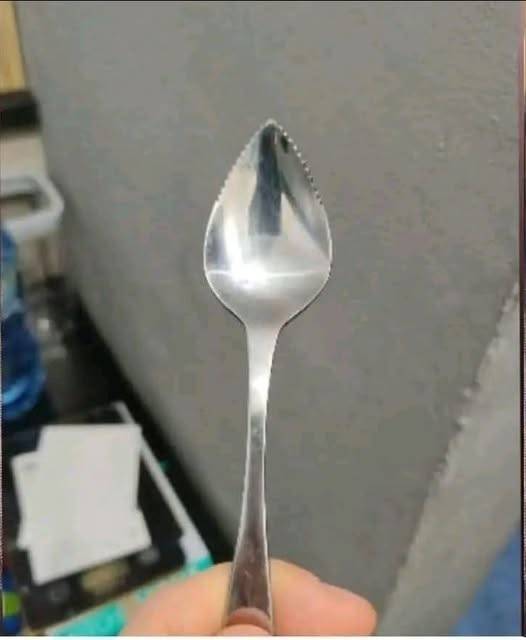
Almost everyone has seen one sitting forgotten in a kitchen drawer at some point. It looks slightly unusual, smaller than a regular spoon, and lined with tiny teeth around the edges. Many people assume it belongs to an old cookware set or mistake it for a decorative serving piece.
Because of its strange appearance, the utensil is often ignored, misplaced, or even thrown away during kitchen cleanouts. Yet the small tool was created for a very specific purpose, and it performs that job far better than most people realize.
The oddly shaped utensil is known as a grapefruit spoon, and despite its simple design, it solves one of the most frustrating problems involved with eating certain fruits.
Why a Regular Spoon Doesn’t Work the Same Way
Anyone who has tried eating grapefruit with a normal spoon knows how awkward it can become. The fruit’s tough membranes cling tightly to the juicy sections inside, making it difficult to separate clean bites without creating a mess.
A regular spoon tends to slide across the surface instead of cutting through it. Knives can help, but they require extra effort and often remove more fruit than necessary.
The grapefruit spoon was designed to handle that exact issue. Its serrated edges gently cut through the membranes while the curved shape scoops out the fruit at the same time.
With a simple motion, the spoon releases neat pieces that lift out easily. Instead of struggling with slippery fruit and dripping juice, the process becomes smooth and controlled.
The Small Serrated Edges Make All the Difference
The tiny teeth around the edge may look decorative, but they are actually the most important part of the design. Those subtle serrations act like miniature blades that slide between fruit sections with precision.
Rather than crushing or tearing the fruit, the spoon separates it carefully. This allows the juicy interior to stay intact while removing only the thin membrane surrounding each section.
The result is cleaner bites, less waste, and far less frustration during preparation and eating.
People who try the spoon for the first time are often surprised by how effortlessly it works. A task that once required patience and multiple utensils suddenly becomes quick and simple.
More Than Just a Grapefruit Tool
Although the utensil was designed for grapefruit, its usefulness extends far beyond a single fruit.
The same serrated edges that cut through grapefruit sections also work beautifully on kiwi. The spoon glides between the soft green fruit and the skin, allowing the inside to lift out neatly in one piece.
It also handles passion fruit with ease. Instead of struggling to scoop out the slippery interior, the spoon’s edges help guide the motion cleanly through the soft center.
Peaches become easier to manage as well. The spoon can trace around the pit while separating the tender fruit without damaging it.
Even avocados benefit from the design. The curved edge follows the shape of the inside perfectly, helping create clean scoops while reducing waste near the skin.
The Tool That Quietly Simplifies Kitchen Work
Many kitchen gadgets promise convenience but end up creating more clutter than value. The grapefruit spoon stands out because it performs a simple task extremely well without taking up much space.
Its usefulness often goes unnoticed because the tool itself appears modest and old-fashioned. There are no moving parts, complicated attachments, or flashy features.
Yet the design solves a very real problem in an elegant way.
Instead of fighting with slippery fruit, sticky fingers, and awkward cutting angles, the spoon allows small, precise movements that feel natural and efficient.
For people who regularly prepare fresh fruit, that small improvement quickly becomes noticeable.
Why So Many People Rediscover It Later
Kitchen drawers are full of forgotten utensils that rarely get used. The grapefruit spoon often ends up among them because many people simply do not know what it is designed to do.
Some inherit the spoon from older family members without ever learning its purpose. Others discover it buried inside mixed silverware collections and assume it is outdated or unnecessary.
But once the utensil is actually used correctly, opinions tend to change quickly.
People often realize that the spoon solves problems they had quietly accepted for years. Fruits that once felt annoying to prepare suddenly become easy and enjoyable to eat.
That transformation is what gives the spoon its surprising staying power.
A Design That Has Barely Needed Improvement
One of the most interesting things about the grapefruit spoon is how little the original concept has changed over time.
The design remains effective because it relies on simple mechanics rather than trends or technology. A curved bowl combined with small serrated edges continues to accomplish the job remarkably well.
In an era where kitchen gadgets constantly evolve and multiply, the grapefruit spoon remains almost unchanged because the original idea already works.
That kind of lasting practicality is rare.
It also explains why many older kitchens still contain these utensils decades after they were first purchased.
The Satisfaction of Using the Right Tool
There is something unexpectedly satisfying about using a utensil designed perfectly for a specific task.
When the grapefruit spoon slips cleanly between fruit membranes, the process feels smooth and efficient in a way regular utensils cannot match.
Instead of tearing fruit apart or struggling to separate sections, the spoon creates clean cuts with minimal effort.
That small improvement changes the entire experience of preparing and eating certain foods.
It turns frustrating kitchen moments into quick, tidy routines.
Why It Continues to Earn a Place in Modern Kitchens
Despite changing food trends and constantly evolving cookware, the grapefruit spoon continues to remain relevant because the problem it solves has never disappeared.
Fresh fruit is still messy, slippery, and difficult to handle in certain situations. The spoon offers a straightforward solution that works repeatedly without complication.
Its versatility also helps it survive beyond its original purpose.
Even people who rarely eat grapefruit often find themselves reaching for the utensil when preparing kiwi, peaches, avocados, or other soft fruits.
Over time, the spoon quietly becomes one of those reliable kitchen items that people use instinctively without thinking much about it.
The Little Utensil Many People Underestimate
At first glance, the grapefruit spoon does not look impressive. Its tiny teeth appear unusual, and its purpose is not immediately obvious.
But hidden inside that simple design is a surprisingly clever solution to a common kitchen frustration.
The utensil combines cutting and scooping into one controlled motion, allowing fruit to separate neatly without extra mess or wasted effort.
That efficiency is what turns skepticism into appreciation after only a few uses.
What many people dismiss as a strange little spoon is actually one of the smartest examples of practical kitchen design.
And once it earns a place in your routine, it becomes difficult to imagine preparing certain fruits without it.