
Homeless Father’s Rescue Puppy Becomes the Lifeline That Helps Him Rebuild His Life
A tense night inside an emergency veterinary clinic
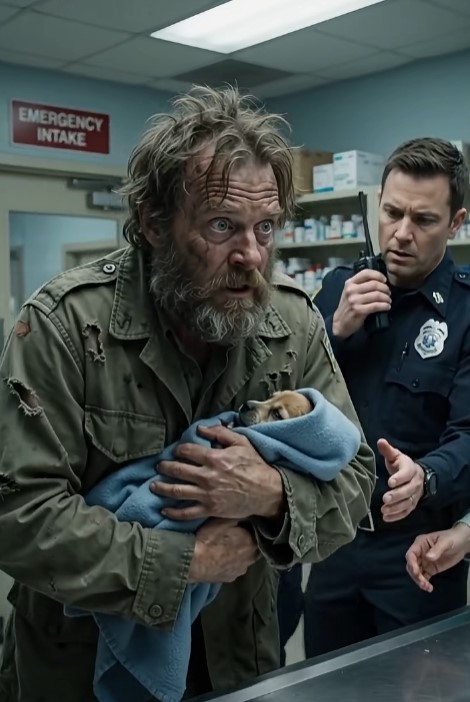
The emergency veterinary clinic had seen countless urgent cases, but the atmosphere changed when Arthur Hayes finally loosened his grip on the faded blue fleece blanket he had carried through the freezing Chicago rain.
An Animal Rescue Officer, her partner Sarah, and emergency veterinarian Dr. Evans surrounded the examination table, uncertain about what they were about to discover. Minutes earlier, Arthur had resisted every attempt to separate him from the bundle.
The officers initially feared that the blanket might conceal evidence of serious animal neglect. After nine years of responding to difficult rescue calls, the officer had learned to prepare for the worst.
Instead, the first sound from inside the blanket was a tiny squeak.
Wrapped beneath the soaked fleece was a severely cold and underweight terrier puppy estimated to be only eight or nine weeks old. Its fur was dirty and wet, its ribs were visible, and its breathing was shallow.
Yet another object hidden beside the puppy immediately changed the meaning of the entire encounter.
The tiny bracelet that explained Arthur’s fear
Resting against the puppy was a small hospital identification bracelet. Its size made it clear that it had belonged to a young child.
When Dr. Evans carefully examined it, Arthur immediately became protective again. He made it clear that the bracelet was extremely important to him and begged the veterinarian to handle it carefully.
The faded identification information carried the name Maya Hayes and identified Pediatric Oncology as the department.
Suddenly, the officers understood that Arthur had not been guarding evidence of cruelty. He had been protecting objects connected to someone he had loved deeply.
The officer who had confronted Arthur in the alley began reconsidering every assumption made during their tense encounter. What had appeared to be aggression now looked more like panic from a grieving man terrified of losing the few things he still considered his own.
Dr. Evans focused immediately on the puppy. Its condition required urgent treatment because prolonged exposure to cold and rain had left it severely hypothermic and dehydrated.
Saving Barnaby from the cold
Arthur explained that he had tried desperately to keep the puppy warm. He had wrapped the animal inside Maya’s fleece blanket, but the storm had eventually soaked through nearly everything.
Dr. Evans believed the blanket had provided enough insulation to help the puppy survive until professional care became available.
The medical team placed the puppy on a warming system and began administering heated fluids. Because Arthur remained deeply anxious about Maya’s belongings, Dr. Evans promised that the blanket and bracelet would remain within his reach.
Only then did Arthur allow the treatment to continue without resistance.
The puppy’s lungs showed some concerning sounds, but its heart rhythm remained strong. Malnutrition, dehydration and hypothermia remained the immediate medical problems.
Arthur watched the veterinary team work and asked only that they save the animal.
The officers soon realized that Arthur himself had also spent too long exposed to the cold. He was soaked, exhausted and shivering inside his damaged military-style jacket.
He reluctantly agreed to move into a nearby consultation room where he could still see the treatment area through a window.
The story behind Maya’s blue blanket
Warm towels and coffee gradually helped Arthur relax. As he carefully dried the blue blanket, he began explaining how his life had reached this point.
Arthur had once worked as a construction foreman. He had steady employment, a truck and a suburban home. Most importantly, he was raising his daughter Maya as a single father.
Maya followed him everywhere and was fascinated by his construction work. She would wear his hardhat around their home and pretend to inspect imaginary building foundations.
After her fifth birthday, however, her health changed dramatically. Bruising, exhaustion and recurring fevers eventually led to a diagnosis of Acute Lymphoblastic Leukemia.
Arthur devoted himself completely to his daughter during her treatment. Hospital stays became a central part of their lives, and he refused to leave Maya alone when she needed him.
His job eventually disappeared. Savings were depleted. His truck was sold, the house was mortgaged, and anything valuable became secondary to trying to extend his daughter’s life.
The faded blue fleece blanket had been Maya’s favorite possession during those hospital stays. Yellow stars had once been clearly visible across the fabric.
When she became frightened or uncomfortable, she would pull the blanket around herself and imagine that it could protect her.
Maya eventually died on a rainy Tuesday morning.
How grief pushed Arthur onto the streets
After Maya’s death, Arthur lost the remaining structure of his life. The house was foreclosed on, his career was gone, and his grief overwhelmed his desire to rebuild.
He gathered a few clothes, Maya’s blanket and her hospital bracelet and began living on the streets of Chicago.
For two years, those two objects became his most treasured possessions. They represented physical reminders that Maya had existed and that Arthur had once lived an entirely different life.
He avoided situations in which he feared losing the blanket or bracelet. Gradually, he became increasingly disconnected from ordinary life.
Arthur admitted that he had reached a point where he no longer cared much about his own survival.
Then, three days before the veterinary clinic encounter, something changed.
A freezing puppy crawls under Maya’s blanket
Arthur had been sleeping near dumpsters by an old packing plant when he awoke during the night and felt movement beneath Maya’s blanket.
A tiny puppy had crawled against his body searching for warmth.
Arthur initially tried to send the animal away. He did not want another responsibility and was frightened by the possibility of becoming attached to something he might lose.
But the weak, frightened animal stayed close to him.
Arthur eventually wrapped the puppy inside Maya’s blanket and began searching for food. For three days, he shared what little protection and warmth he possessed.
He named the puppy Barnaby because Maya had once said that Barnaby was the name she wanted to give a dog if they ever had one.
The rescue officer listening to Arthur’s story now faced a complicated problem. Barnaby clearly needed safe indoor housing after leaving the clinic, but Arthur had no permanent address and almost no money.
A decision that changed everything
Under standard procedure, a stray puppy without adequate housing could have entered the municipal shelter system. Arthur feared that outcome because he knew he might not satisfy adoption or reclaim requirements.
To him, losing Barnaby would mean losing the first living creature he had allowed himself to care about since Maya’s death.
The officer decided she could not allow that to happen.
Sarah initially worried about the professional consequences of departing from normal procedure, but after seeing Maya’s bracelet and understanding Arthur’s circumstances, she joined the effort to find another solution.
Dr. Evans also became involved. Barnaby’s medical treatment had already created significant costs, but the veterinarian arranged for the clinic’s charity resources to cover them.
More importantly, Barnaby would need approximately seventy-two hours of medical observation before discharge.
That gave the officers three days to help Arthur find a safe place where both he and Barnaby could live.
One phone call creates an opportunity
The rescue officer remembered Marcus Thorne, the owner of a commercial construction company on Chicago’s South Side.
Five years earlier, she had helped save a badly injured pit bull that ran toward traffic near one of Marcus’s construction sites. Marcus eventually adopted the dog and named her Diesel.
At the time, Marcus had offered to return the favor someday.
Now the officer called him in the middle of the night.
She explained that Arthur was a former construction foreman who had been homeless for two years following his daughter’s death. She also described Barnaby and the seventy-two-hour deadline.
Marcus was initially cautious. Hiring someone who had spent years away from the workforce represented a risk for his company.
He nevertheless agreed to meet Arthur at 8 a.m. and consider giving him an opportunity.
There was another possibility on the construction site: an old manager’s trailer that could potentially provide Arthur and Barnaby with temporary housing.
Preparing Arthur for a job interview
When Arthur learned about the opportunity, he initially struggled to imagine any employer hiring him. Two years outdoors had left his clothes damaged and his appearance badly neglected.
Sarah refused to let him give up.
The officers arranged a motel room where Arthur could take a hot shower and rest. They then purchased work jeans, a flannel shirt, thermal clothing, wool socks, steel-toed boots and basic personal-care supplies.
After shaving and cleaning himself, Arthur barely recognized the man looking back from the motel mirror.
The transformation did not erase his grief, but it revealed something that had been hidden beneath two years of hardship. Arthur once again looked like an experienced construction worker preparing for a job site.
Shortly before 8 a.m., they arrived at Marcus Thorne’s Monroe Street project.
Arthur gets his chance
Marcus met Arthur outside the manager’s trailer with Diesel beside him.
Arthur explained his background in commercial framing and described his experience operating equipment, working with blueprints and handling job-site requirements.
Marcus then asked the difficult question: how had someone with that experience ended up homeless?
Arthur answered without avoiding the truth.
He explained Maya’s illness, the money he spent trying to save her and the collapse that followed her death. He also explained how finding Barnaby had given him his first reason in two years to begin fighting for a future again.
Arthur promised that if Marcus gave him an opportunity, he would work harder than anyone on the site.
Marcus offered him cleanup work at minimum wage and access to the manager’s trailer. If Arthur proved his skills, they could discuss greater responsibilities later.
Arthur started work almost immediately.
Seventy-two hours of progress
While Barnaby continued recovering at the veterinary clinic, Arthur threw himself into construction work.
Marcus soon discovered that Arthur’s experience had not disappeared during his years away from the industry. He organized materials, repaired equipment and kept his living area clean.
At the clinic, Barnaby improved just as quickly.
Once his body temperature returned to a safer level, the puppy began eating high-calorie food and showing more of his energetic personality.
By the second day, Marcus described Arthur as an exceptionally hard worker who clearly understood construction far beyond basic cleanup duties.
Friday finally arrived, bringing the moment Arthur had been waiting for: Barnaby’s discharge.
Barnaby finally goes home
Arthur arrived at the clinic wearing a high-visibility vest and hardhat, with a tape measure attached to his belt. In only three days, he already looked increasingly comfortable in the working life he once knew.
Barnaby’s transformation was just as noticeable.
The puppy’s fur was clean and fluffy, his body temperature had stabilized, and he was far more energetic than the nearly frozen animal pulled from Maya’s blanket days earlier.
When the kennel opened, Barnaby rushed directly toward Arthur.
The reunion left little doubt about the bond that had developed between them during their brief time together on the streets.
Dr. Evans confirmed that Barnaby had received his first vaccinations and had recovered well enough to leave the clinic.
Arthur brought him back to the manager’s trailer, where he had already purchased a dog bed, food, puppy supplies and toys.
He placed Maya’s faded blue blanket over Barnaby’s new bed.
For the first time, however, the hospital bracelet no longer had to remain hidden inside the blanket for protection from rain or loss. Arthur placed it safely above Barnaby’s sleeping area.
The puppy curled up on Maya’s blanket and went to sleep inside a warm home.
One year later, life looks very different
Arthur continued working for Marcus and gradually rebuilt the stability he had lost after Maya’s death.
Six months later, Marcus promoted him to Lead Project Manager.
Arthur saved his earnings and eventually moved out of the construction trailer. He rented a two-bedroom apartment in the suburbs with a fenced backyard.
Barnaby grew from a dangerously underweight puppy into an energetic fifty-pound terrier mix. He began accompanying Arthur in his work truck and even wore a small high-visibility vest of his own.
Sarah also moved forward professionally, passing her sergeant’s exam and taking responsibility for her own sector.
The Animal Rescue Officer remained in the same career, but the encounter permanently changed the way she viewed people living on the streets. Arthur’s experience had shown her how much history could remain invisible beneath a person’s appearance.
Maya’s memory remains at the center of Arthur’s new life
Inside Arthur’s new home is a custom shadow box displaying the most important reminders of Maya.
The faded blue fleece provides the background.
Her tiny pediatric hospital bracelet rests safely behind the glass.
Beneath it is a small brass plaque carrying three words: “Love Never Fails.”
Arthur never stopped grieving his daughter, and Barnaby did not replace her. Instead, the puppy became the unexpected reason Arthur began caring about tomorrow again.
A freezing animal had needed Arthur at the same moment Arthur desperately needed something to protect.
Saving Barnaby forced him to search for warmth, medical care and safety for another living creature. In doing so, Arthur gradually found those things for himself as well.
What began with a soaked blanket, a tiny hospital bracelet and a frightened puppy eventually became a story of work, housing, companionship and renewed purpose.
Arthur had entered the veterinary clinic believing he was about to lose Barnaby. Three days later, he walked away with the puppy, a job and a place to live.
A year later, the man who once slept beneath Chicago overpasses was managing construction projects, living in his own home and sharing his days with the dog that had crawled beneath Maya’s blanket looking for warmth.