
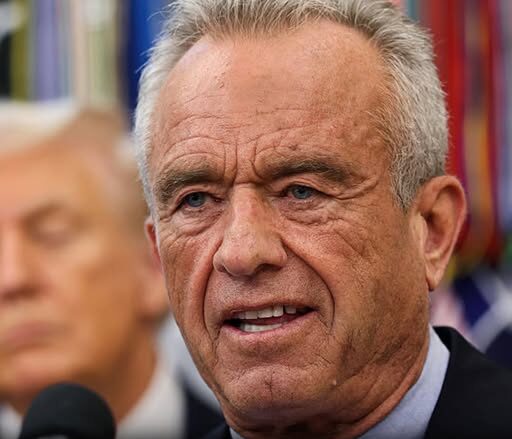
Robert F. Kennedy Jr.’s Tylenol and Autism Remarks Ignite Alarm Over Public Health Messaging
Cabinet Meeting Remarks Spark New Controversy
A closed-door Cabinet meeting turned tense after Health Secretary Robert F. Kennedy Jr. repeated a claim that has already drawn sharp concern from medical experts and public health voices around the world.
The remarks centered on Tylenol, pregnancy, autism, circumcision, and a political phrase that quickly intensified the reaction: “Trump derangement syndrome.”
The room reportedly fell silent as Kennedy repeated the claim and then pushed further, creating a new flashpoint at the uneasy intersection of politics, parental fear, and public trust in medicine.
At the center of the controversy is the suggestion that a common over-the-counter painkiller used by millions of people could be linked to autism when taken during pregnancy.
Even more troubling to critics is that Kennedy openly acknowledged there is no proof while still placing the idea into the center of a national health discussion.
A Claim Without Proof Raises Public Health Concerns
The concern surrounding Kennedy’s remarks is not limited to disagreement over one statement.
The larger issue is the authority of the office he holds and the effect his words may have on the public, especially pregnant women, parents, and families already navigating difficult health decisions.
When a private citizen speculates about medicine, the impact is limited by context.
When the person responsible for national health policy does the same, the words carry far greater weight.
That difference is what has made the latest remarks so alarming to scientists, autism advocates, and former leaders who view the comments as more than political theater.
They see them as an example of how unsupported claims can move from the margins into official public conversation.
The danger is not only that people may believe the claim.
The danger is that they may change behavior based on fear rather than evidence.
Pregnancy, Pain Relief, and Public Anxiety
Pregnancy is already a period filled with uncertainty, pressure, and constant decision-making.
Expectant parents are often told to weigh every food, medication, symptom, and routine choice against possible risk.
Introducing an unproven connection between Tylenol and autism adds another layer of fear to an already stressful experience.
For critics, the most damaging part of the remark is not that it opened a conversation about medication safety.
Public health questions deserve careful attention.
The problem is that the claim was presented in a way that suggested danger while also conceding the absence of proof.
That combination can leave the public confused, frightened, and unsure whom to trust.
People who need pain relief during pregnancy may hesitate, panic, or make decisions without clear medical guidance.
Parents may blame themselves for choices made years earlier.
Families may search for a single cause where none has been established in the remarks provided.
Autism Families React to the Language of Prevention
The remarks also touched a deeper nerve among autistic people and their families.
For many, public conversations about autism often focus heavily on cause, blame, and prevention while failing to recognize the dignity and humanity of autistic people themselves.
That is why the framing matters.
When autism is discussed only as something to be avoided, reduced, or “prevented,” many families hear something painful behind the policy language.
They hear a suggestion that their children’s lives are being treated as a public problem rather than as human lives with complexity, value, and worth.
This is part of why advocates have reacted so strongly.
The concern is not simply that Kennedy raised an unsupported medical claim.
The concern is that the claim may deepen stigma while giving anxious parents another reason to fear their children’s future.
For families already fighting for acceptance, services, understanding, and respect, the remarks reopened a familiar wound.
Science, Politics, and the Collapse of Trust
The controversy also reflects a broader problem in public life: the growing conflict between scientific caution and political certainty.
Medicine often moves carefully.
It relies on evidence, review, verification, and restraint.
Politics often rewards confidence, speed, provocation, and emotional impact.
When health messaging becomes political messaging, the public can struggle to separate medical guidance from ideological performance.
Kennedy’s comments have landed in that exact space.
The issue is no longer only about Tylenol, pregnancy, or autism.
It is about whether national health leadership can maintain credibility while making claims that experts have described as dangerous and unsupported.
For many observers, the answer depends on whether public officials treat evidence as the foundation of their message or as an obstacle to their preferred narrative.
In health policy, that distinction can have real consequences.
The Weight of Words From a Health Secretary
Every public official’s words matter, but the words of a health secretary carry particular force.
People look to health leaders during moments of confusion, fear, illness, and uncertainty.
They expect those leaders to separate what is known from what is suspected and what is merely speculation.
That responsibility becomes even more important when the topic involves pregnancy and children.
A suggestion made without proof can still shape decisions in households across the country.
A phrase repeated in a Cabinet meeting can become a talking point, a headline, a warning shared between parents, or a reason someone avoids care.
That is why critics argue that evidence is not a technical detail in this case.
It is the core issue.
Public trust depends on the belief that health guidance is grounded in facts rather than political pressure or personal conviction.
Once that trust weakens, even accurate information can become harder for people to accept.
Fear Can Spread Faster Than Clarification
One of the most difficult challenges in public health communication is that fear often travels faster than correction.
A simple claim can spread quickly, especially when it involves children, pregnancy, or a familiar household medicine.
By the time careful explanations arrive, many people may already remember only the warning.
That is why unsupported medical speculation from a powerful official can be so damaging.
It does not need to be proven to influence behavior.
It only needs to sound alarming enough to take root.
Parents may begin to question past decisions.
Pregnant women may feel guilt over ordinary choices.
Families may face renewed anxiety about autism and childhood development.
Medical professionals may then be forced to spend time undoing confusion that did not have to exist in the first place.
Free Speech and Public Responsibility
The controversy has also revived a familiar debate about free speech and responsibility.
Public officials have the right to speak, challenge assumptions, and question existing systems.
But critics argue that holding high office comes with a duty to speak carefully, especially on matters involving health.
Free speech does not erase the consequences of public statements.
It does not remove the obligation to distinguish evidence from suspicion.
It does not protect the public from confusion when speculation is delivered with the authority of government.
In this case, the concern is not that a difficult topic was discussed.
The concern is that the discussion may have elevated fear without giving the public a reliable foundation for understanding the risk.
That is a serious matter when the subject involves pregnancy, medication, and autism.
Autism Should Not Become a Political Weapon
Another troubling part of the episode is the way autism can become entangled in political conflict.
When discussions about autism are shaped by blame, outrage, or partisan framing, autistic people can become symbols in a fight that is not truly about their lives.
Families dealing with autism need support, services, respect, and clear information.
They do not need their children’s existence turned into a political warning.
They do not need another public debate that treats autism as a tragedy to assign to a product, a parent, a pregnancy decision, or a political enemy.
That is why advocates have pushed back so strongly against language that reduces autism to something society should fear above all else.
The way leaders speak about autism can influence how autistic people are treated in schools, homes, workplaces, and communities.
Words from powerful figures can either reduce stigma or deepen it.
A Moment That Tests Public Health Leadership
Kennedy’s remarks now stand as a test of public health leadership during a time of intense distrust.
Many people are already uncertain about institutions, medical advice, and government authority.
In that climate, unsupported claims can do lasting damage.
The public needs leaders who are willing to acknowledge uncertainty without turning uncertainty into fear.
People need clear distinctions between what is known, what remains unknown, and what has not been proven.
They need reassurance that health policy is not being shaped by political instinct before evidence.
The reaction to Kennedy’s comments shows how fragile that confidence has become.
It also shows how quickly one statement can become larger than itself when it touches the deepest concerns of parents and families.
Evidence Remains the Central Obligation
The central issue is not whether public officials may ask hard questions.
They can and often should.
The issue is how those questions are presented when millions of people may act on the answers they think they hear.
Suggesting a possible link between a common medication and autism while conceding there is no proof creates a dangerous gray area.
It gives fear the sound of warning without giving the public the certainty needed to make responsible decisions.
That is why scientists, advocates, and former leaders are not merely irritated by the remarks.
They are alarmed by what those remarks represent.
In public health, evidence is not a luxury reserved for academic debate.
It is a moral obligation because the consequences of confusion are carried by real people.
Pregnant women, parents, autistic people, and families deserve better than speculation wrapped in authority.
They deserve clarity, restraint, and leadership that understands the power of its own words.